Showing posts with label s. Show all posts
Showing posts with label s. Show all posts
Tuesday, February 28, 2017
GAME for FREE Tom Clancy s Splinter Cell Coming soon! Now Live
GAME for FREE Tom Clancy s Splinter Cell Coming soon! Now Live

Splinter Cell is available for FREE starting from July 13th, 2016. (See the announcement by PC Gamer)

Infiltrate terrorists positions, acquire critical intelligence by any means necessary, execute with extreme prejudice, and exit without a trace!
You are Sam Fisher, a highly trained secret operative of the NSAs secret arm: Third Echelon. The world balance is in your hands, as cyber terrorism and international tensions are about to explode into WWIII.
Grab "Tom Clancy s Splinter Cell" for FREE here! (Now Live!)
Good luck and have fun with this game!
Available link for download

Saturday, February 25, 2017
FREE PDF HUAWEI Mate S User Guide Free Download
FREE PDF HUAWEI Mate S User Guide Free Download
FREE PDF : HUAWEI Mate S User Guide Free Download.
HUAWEI Mate S user manual has been released by Huwawei at their website. The HUAWEI Mate S user guide or owners manual is provided in PDF file format (99 pages, 28.4 MB). The HUAWEI Mate S user guide / owners manual gives you any references how to operate HUAWEI Mate S correctly.

Table Contents of HUAWEI Mate S User Guide
- Foreword
- Highlights
- Getting Started
- Calls and Contacts
- Messaging and Email
- Camera and Galerry
- Music and Videos
- Network and Sharinf
- Apps
- Phone Settings
- Safety Information
- Legal Notice
How to Locking and Unlucking the Screen HUAWEI Mate S
Locking the screen
• Method 1: Press the power button to manually lock the screen.
• Method 2: After being idle for a specified period of time, the screen will lock
• Method 1: Press the power button to manually lock the screen.
• Method 2: After being idle for a specified period of time, the screen will lock
itself automatically.
Unlocking the screen
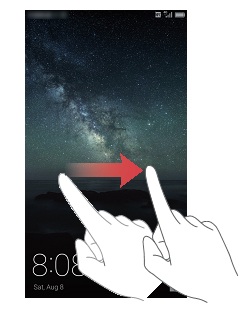
When the screen is off, press the power button to turn it on. Slide your finger in any direction to unlock the screen.
Unlocking the screen
When the screen is off, press the power button to turn it on. Slide your finger in any direction to unlock the screen.
How to Connecting HUAWEI Mate S To A Computer
Use a USB cable to connect your phone to a computer. Follow the onscreen instructions and select a connection mode to transfer photos, videos, songs, and other files between your phone and computer.
Photos : Read, manage, and transfer multimedia files in your phone storage. For details, see Connecting in picture transfer mode.
Files : Read, manage, and transfer files in your phone storage. For details, see Connecting in media transfer mode.
Files : Read, manage, and transfer files in your phone storage. For details, see Connecting in media transfer mode.
USB drive : If you have a microSD card installed, you can use your phone as a USB storage device, read data on the microSD card, and transfer data to and from a computer. For details, see Connecting in USB flash drive mode
How To Importing Contacts From Your Old Phone
You can import contacts from your old phone in any of the following ways:
SIM card : Copy your contacts on your SIM card to your new phone. For details, see Importing contacts from a SIM card .
Storage device : If your old phone has a microSD card slot, export the contacts in your old phone to a microSD card as a vCard file, and then import the contacts to your new phone. For details, see Importing contacts from a storage device .
Bluetooth : Enable Bluetooth on both your old and new phones, and import your contacts usin g Bluetooth. For details, see Importing contacts from a Bluetooth device .
Backup : If your old phone supports Backup, back up your contacts, and restore them to your new phone. For details, see Backup.
Computer : Synchronize your contacts from your old phone to a computer, and use phone management software on the computer, such as HiSuite, to synchronize them to your new phone.
Other accounts :
SIM card : Copy your contacts on your SIM card to your new phone. For details, see Importing contacts from a SIM card .
Storage device : If your old phone has a microSD card slot, export the contacts in your old phone to a microSD card as a vCard file, and then import the contacts to your new phone. For details, see Importing contacts from a storage device .
Bluetooth : Enable Bluetooth on both your old and new phones, and import your contacts usin g Bluetooth. For details, see Importing contacts from a Bluetooth device .
Backup : If your old phone supports Backup, back up your contacts, and restore them to your new phone. For details, see Backup.
Computer : Synchronize your contacts from your old phone to a computer, and use phone management software on the computer, such as HiSuite, to synchronize them to your new phone.
Other accounts :
• Install social network applications and synchronize contacts from your social network accounts.
• Log in to your Exchange account and synchronize your contacts.
• Log in to your Exchange account and synchronize your contacts.
HUAWEI Mate S Touchscreen Gestures
Touch: Tap an item once. For example, touch to confirm an action or open an
application.
application.
Touch and hold : Touch and leave your finger on the screen for 2 seconds or more. For example, touch and hold a blank area on the home screen to enter editing mode.
Swipe : Move your finger vertically or horizontally across the screen. For example, you can swipe left or right under Notifications in the notification panel to dismiss a notification. Swipe horizontally or vertically to transition through home screens, scroll through a document, and more.
Drag: Touch and hold an item and then move it to another position. For example, you can rearrange applications and widgets on the home screen this way.
Swipe : Move your finger vertically or horizontally across the screen. For example, you can swipe left or right under Notifications in the notification panel to dismiss a notification. Swipe horizontally or vertically to transition through home screens, scroll through a document, and more.
Drag: Touch and hold an item and then move it to another position. For example, you can rearrange applications and widgets on the home screen this way.
Pinch two fingers out : Spread two fingers apart on the screen. For example, pinch two fingers out to zoom in on a picture or web page.
Pinch two fingers together: Pinch two fingers together on the screen. For example, pinch two fingers together to zoom out on a picture or web page.
Pinch three fingers together: On the home screen, pinch three fingers together to display screen thumbnails.
Pinch two fingers together: Pinch two fingers together on the screen. For example, pinch two fingers together to zoom out on a picture or web page.
Pinch three fingers together: On the home screen, pinch three fingers together to display screen thumbnails.
Status Icons of HUAWEI Mate S
Status icons may vary according to your region or carrier.
Status icons may vary according to your region or carrier.


Home Screen of HUAWEI Mate S
Your home screens are where you can find your favorite widgets and all your applications. We did away with the application list to give you a more convenient and direct path to yo ur applications.
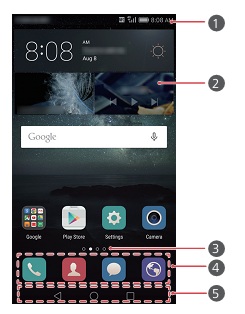
- Status bar: displays notifications and icons. Swipe down from
the status bar to open the notification panel. - Display area: displays applicatio n icons, folders, and widgets.
- Screen position indicator: indicates which home screen is
displayed. - Dock: displays frequently used applications.
- Navigation bar: displays virtual ke ys (only applicable to phones
with virtual navigation keys).
The following download link is for HUAWEI Mate S user guide manual. The manual is provided by nokia.com. The manual offers comprehensive information about the phone that would be useful for any of you who are using this mobile phone.
Download FREE HUAWEI Mate S user guide.pdf
Download FREE HUAWEI Mate S user guide.pdf
Available link for download
Wednesday, February 15, 2017
Galaxy S Advance i9070 Android 4 1 2 Root And Delete Unwanted System Apps To Speed Up The Device
Galaxy S Advance i9070 Android 4 1 2 Root And Delete Unwanted System Apps To Speed Up The Device
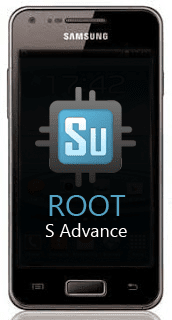 Samsung Galaxy S Advance, one of the old successor in Galaxy series cant manage to run Android 4.1.2 smoothly due to its average specs. The device packed with a Dual-core 1 GHz Cortex-A9 CPU and 768 MB of RAM memory. As a Samsung device S Advance also bloated with many Samsung apps like ChatOn, S Voice, Samsung App store, etc. Many of the users not uses most of these pre installed apps and they are not able to remove these system apps due to lack of root permission.
According to many Galaxy S Advance users, the device freezes frequently even after the update to the available latest update Android 4.1.2. As Samsung hasnt released an update fix to the S Advance, the only solution which prevents the device from frequent freezing is clearing the ROM memory by removing the unwanted System apps. You can remove any of the system app by gaining root access.
In this post I included the simplest and best way to root Samsung Galaxy S Advance without using Computer. This root process is safer as it will not change the kernel and will not increase the binary count.
Note:
- This root is only for Galaxy S Advance i9070 Android 4.1.2
- Minimum 50% charge required
- Rooting may void warranty
- I am not responsible for any damage do at your risk.
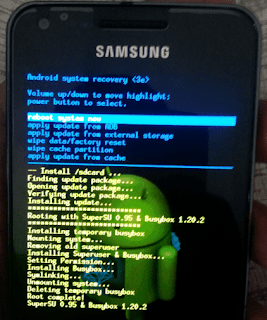
Galaxy S Advance Android 4.1.2 Root
1. Download root.zip - Download2. Copy root.zip to external SD card.
3. Reboot S Advance to recovery mode ( Volume up + Home + Power ).
4. In recovery select apply update from external storage.
( use volume buttons to navigate and power button to select )
5. On the next screen, select root.zip and wait to finish installation.
6. Finally ... Go back and select reboot system now.
Thats it...
After root you can remove any system apps to get more free memory, which will speed up your S Advance. Follow the below post to uninstall system apps.
How To Remove System Apps in Android ?
Available link for download
Saturday, February 4, 2017
Drivers USB Samsung GAlaxy S 1 3 450 0
Drivers USB Samsung GAlaxy S 1 3 450 0
Paket yang disediakan disini adalah file instalasi untuk driver USB untuk perangkat Samsung Galaxy S.
Catatan Penting yang harus kamu perhatika
Hal ini sangat dianjurkan untuk selalu menggunakan versi driver terbaru yang tersedia.
Jangan lupa untuk memeriksa situs ini sesering mungkin agar kamu tetap update driver , software maupun game terbaru.
Cobalah untuk mengatur sistem restore point sebelum menginstal driver perangkat. hal Ini akan membantu kamu jika kamu gagal atau salah dalam menginstal driver. Masalah ini bisa saja timbul karena perangkat keras kamu udah terlalu jadul atau tidak disupport lagi.

Catatan Penting yang harus kamu perhatika
- Selama instalasi file ini, pastikan bahwa Anda login sebagai Administrator atau sebagai pengguna dengan hak administratif.
- Untuk memastikan bahwa tidak ada program lain mengganggu instalasi, simpan semua pekerjaan dan tutup semua program lain.
- Hal ini sangat disarankan agar Anda mengcopy petunjuk ini untuk digunakan sebagai referensi selama proses instalasi.

Hal ini sangat dianjurkan untuk selalu menggunakan versi driver terbaru yang tersedia.
Jangan lupa untuk memeriksa situs ini sesering mungkin agar kamu tetap update driver , software maupun game terbaru.
Cobalah untuk mengatur sistem restore point sebelum menginstal driver perangkat. hal Ini akan membantu kamu jika kamu gagal atau salah dalam menginstal driver. Masalah ini bisa saja timbul karena perangkat keras kamu udah terlalu jadul atau tidak disupport lagi.
Available link for download
Wednesday, January 25, 2017
Foxconn L S 36 Bios
Foxconn L S 36 Bios
Here you can download foxconn l s 36 bios for Windows. Its 100% safe, uploaded from safe source and passed McAfee virus scan!
Driver Info:
File name: foxconn-l-s-36-bios.zip
Driver version: 2.0.4
File size: 11 520 KB
OS: Win 7, Win Vista, Win 560
Upload source: manufactuter website
Available link for download
Tuesday, January 3, 2017
Fedora 22 Released See What s New Workstation
Fedora 22 Released See What s New Workstation

Fedora 22 Workstation was released today and it ships with the latest stable GNOME 3.16, a new default package manager and other interesting changes. Lets take a look at whats new!
GNOME 3.16
Fedora 22 Workstation ships with GNOME 3.16 by default and the most important change in this release is probably the new notification system, which has replaced the old Message Tray.
In GNOME 3.16, the notification history can now be accessed from the date/time menu (the calendar widget from the Top Bar):

... while legacy "tray" icons are displayed in an expandable "drawer" that uses autohide and its available in the bottom left corner of the screen:

Furthermore, the notification popups, called "banners", are now displayed at the top of the screen:

In the screenshot above you should notice a dot next to the date/time indicator - this indicates unread notifications.
Other changes in GNOME 3.16 include:
- refreshed GNOME Shell theme (including monochrome icons for the applications menu);
- scrollbars are displayed only when needed (see screenshot below);
- GTK+ 3.16:
- OpenGL support;
- themes can now simultaneously support multiple GTK+ versions, by including version-specific CSS;
- a new widget called GtkPopoverMenu was added and it can be used for creating menus contained with popovers;
- many GTK+ Inspector changes including a much improved user interface;
- GNOME apps:
- GNOMEs Image Viewer has been redesigned and it now uses header bars;
- Files (Nautilus) 3.16 comes with bigger icons/thumbnails by default, reorganized menus, improved grid and list views as well as a new popover for changing between views, zoom level and sort order. Also, with the latest Files app, users can now move files and folders to the trash using the Delete key instead of Ctrl + Delete, like in previous versions;
- Installation of GStreamer codecs, fonts, and certain document types is now handled by Software;
- Maps can now display information bubbles which show the address, wheelchair accessibility along with links to Wikipedia articles. Also, the latest GNOME Maps comes with built-in Foursquare support, which allows you to check-in;
- Calculator now displays previous calculations so you can easily copy previous figures;
- Boxes comes with an updated properties interface, a new menu makes it possible to send keyboard shortcuts that cannot be entered directly into a box and more;
- smart playlists have been added to Music, so you can view frequently played and recently added tracks. It is now also possible to star your favorite tracks;
- two new games were added: a sliding blocks game called Taquin and 2048;
- three new preview applications were added: Calendar (which already comes with Google Calendar sync), Characters (character map application) and Books (e-book viewer) - these are not installed by default in Fedora 22 but are available in the repositories;
- a new IDE for GNOME, called "Builder", is now available as an early preview (its not installed by default but its available in the repositories).
See our GNOME 3.16 article for more information (including a video).
Here are a few screenshots with some of the changes mentioned above, taken under Fedora 22 Workstation:


Other changes
Fedora 22 Workstation includes quite a few under the hood changes, including a new default package manager: DNF (under the hood, it uses an improved dependency solver, called hawkey, along with librepo for repository operations and libcomps for package groups), which has replaced Yum.
DNF provides better performance and memory footprint along with a "strict API definition for plugins and extending projects", notes the Fedora 22 release announcement.
DNF provides better performance and memory footprint along with a "strict API definition for plugins and extending projects", notes the Fedora 22 release announcement.
Most DNF commands are similar to Yum (and /usr/bin/yum now redirects to /usr/bin/dnf, with a deprecation notice) and the same RPM package repositories are used however, there are some differences:
- updates that dont work are skipped - this is similar to Yums "--skip-broken" (which isnt available for DNF), but it evaluates the impact of the problem against the entire transaction;
- repositories that dont work are skipped;
- dependencies are not upgraded on package installation;
- when removing a package, DNF will automatically remove any dependent packages that were not explicitly installed by the user;
- by default, DNF will check for updates in configured repositories hourly, starting ten minutes after the system boots;
- unlike with Yum, DNF allows removing all kernel packages, including running package.
Even more changes:
- the Software tool and PackageKit now support searching for packages in disabled repositories;
- Fedora 22 introduces the Preupgrade Assistant (not installed by default), a diagnostics utility which assesses the system for possible in-place upgrade limitations and provides a report with the analysis results;
- GDM uses Wayland by default, instead of Xorg, bringing the transition to Wayland one step closer. The default GNOME session continues to use X;
- input devices use a new driver: "libinput", which replaces other drivers such as synaptics, and provides improved support for multi-touch devices and software emulated buttons (this is only installed by default on new Fedora 22 installations);
- The default console font has been changed to eurlatgr in Fedora 22. The new font has the same typeface as the previously used latarcyrheb-sun16 font, but supports a broader range of characters from the Latin and Greek alphabets as well as some commonly used symbol;
- The Terminal now notifies you when a long running job completes (this is a Fedora-specific feature, thats why I didnt include it in the GNOME 3.16 changes above).
Default packages

Fedora 22 Workstation ships with Firefox 38.0.1, LibreOffice 4.4.3.2, Shotwell 0.22.0, Rhythmbox 3.2.1, Transmission 2.84, Empathy 3.12.10 along with version 3.16.x of the core GNOME applications (Nautilus, Gedit, Terminal and so on), on top of GNOME Shell 3.16.2 and GTK+ 3.16.3.
Under the hood, Fedora 22 Workstation uses the Linux Kernel 4.0.4, systemd 209, Mesa 10.5.4 and Xorg Server 1.17.1.
Download Fedora 22
Before installing Fedora 22, make sure you check out the common bugs list and the official release notes.

Its also important to mention that three new websites were released along with Fedora 22 today:
- arm.fedoraproject.org - Fedora Images for ARM Computers;
- spins.fedoraproject.org - Alternative desktops for Fedora (KDE Plasma, Xfce, LXDE, MATE-Compiz and SoaS);
- labs.fedoraproject.org - Fedora bundles.
To easily install codecs, Java and various popular apps that arent available in the Fedora repositories, along with tweaks such as improved font rendering, you can use Fedy, a Fedora post-install utility which was updated to version 4.0 recently and it already supports Fedora 22.
info via

Available link for download
Subscribe to:
Posts (Atom)