Showing posts with label files. Show all posts

Sunday, February 26, 2017

FlashTool version 0 9 18 1 allows you to download Xperia firmware files

FlashTool version 0 9 18 1 allows you to download Xperia firmware files


FlashTool version 0.9.18.1 allows you to download Xperia firmware files.

FlashTool is one of the most powerful tools for Sony Xperia devices and has been around since the Xperia X10 days. The utility has been updated to version number 0.9.18.1, which brings a very useful new feature – the ability to download the latest firmware files for your Sony Xperia device.

Once you have downloaded the latest version, simply head over to the Update Checker part of the tool to select and download your firmware. In theory, this negates the need to use two tools (XperiFirm and FlashTool) to create a FTF firmware file as detailed in our recent guide. See some steps below in how to take advantage of this.

FlashTool 0.9.18.1 changelog

– Updated Java8 to u20
– Update checker can now download the checked version (Devices -> Updates … choose the device … then double click on a table row
to get the latest version. Double click again to download. FTF bundler will open upon download)
– Towelroot hack implemented.

FlashTool (0.9.18.1) – Steps to download firmware

FlashTool_0.9.18.1 _1You can download the latest version of FlashTool from the link below.

DOWNLOAD: FlashTool (0.9.18.1) [Mirror]


To check firware on your handset, go to “Devices” > “Check Updates”
FlashTool_0.9.18.1 _2


This will bring up the Device Selector for you to choose your mobile.
FlashTool_0.9.18.1 _3
Now click on your phone variant which will load a list of customisation versions for various carriers & regions. Click on the version to find out the latest firmware version.
FlashTool_0.9.18.1 _5
Once you have chosen your firmware, you can start the download by double-clicking on the firmware. The message at the bottom of the screen will then change to “Decrypting FileSets” and then “Creating Bundle”.
FlashTool_0.9.18.1 _6
This will then bring up the Bundler as seen in the screen below. Select all items on the left side of the screen, move it to the right and then click “Create” which will then create a FTF firmware file.
FlashTool_0.9.18.1 _9

 Flashing Files


Available link for download

Read more »

Sunday, December 18, 2016

Encrypt Your Cloud Files With Cryptomator Open Source Cross Platform

Encrypt Your Cloud Files With Cryptomator Open Source Cross Platform


Cryptomator is a free and open source client-side encryption solution for your cloud files, available for Linux, Windows and Mac OS X, as well as iOS. An Android app is currently under development.


Cryptomator is advertised as being especially developed to encrypt your cloud files from services such as Dropbox, Google Drive, Mega and other cloud storage services that synchronize with a local directory. 

Since the encryption is done on the client side, it means that no unencrypted data is shared with any online service.

Furthermore, you can use Cryptomator to create as many vaults as you want, each having individual passwords.

For the encryption, Cryptomator uses AES with 256-bit keys. For an extra layer of security, directory structures, filenames and file sizes get obfuscated, while the passphrase you set for encryption is protected against bruteforce attempts using Scrypt. The Cryptomator security architecture page has more information regarding its encryption / privacy.

I should also mention that Cryptomator uses WebDAV to mount the vaults and this causes some issues on Linux, like not being able to open LibreOffice files directly from the unlocked vault (although this didnt occur in my test under Ubuntu 16.04) - bug report. In the future, Cryptomator may switch to FUSE on Linux and OS X to avoid such issues.


How to use Cryptomator


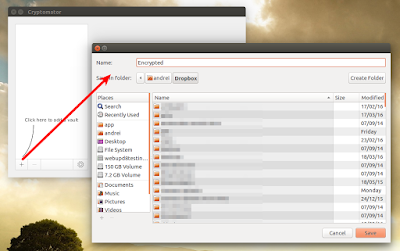
Lets create your first vault using Cryptomator. Launch the application and click "+" to add a new vault, then browse the location where you want to create it.

For instance, if you want to create a folder called "Encrypted" in your Dropbox directory, select the Dropbox directory and enter "Encrypted" as the vault name, then click "Save":


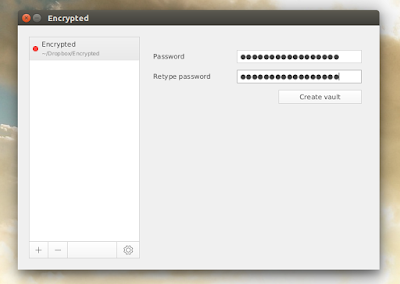
Then enter a password for the newly created vault and click "Create vault":


Thats it!

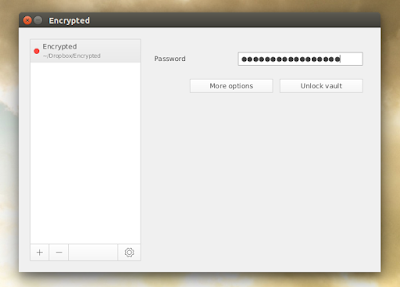
Now to copy some files in your vault, youll need to unlock it, so enter your password and click "Unlock vault":


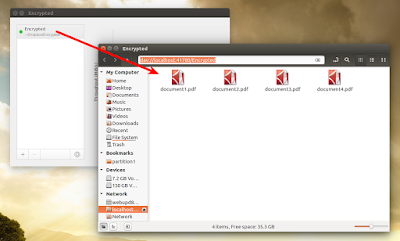
After clicking "Unlock vault", your unlocked vault (which is mounted via WebDAV) should open in the default file manager:


Any files you copy here are synchronized as encrypted with Dropbox (or whatever other cloud storage service you use).

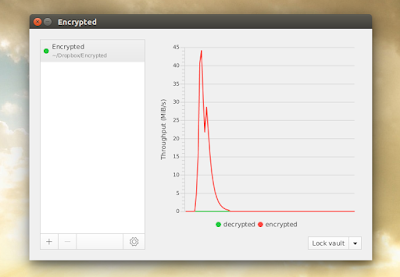
Note that you cant close Cryptomator while a vault is unlocked. If you try to close the application while a vault is unlocked, the app is minimized. To be able to close the application you need to re-lock the vault, by clicking "Lock vault".


Download Cryptomator


Download Cryptomator | source
(binaries: 32bit and 64bit deb files for Ubuntu / Debian, Windows and Mac OS X binaries as well as a generic JAR executable)

Note that if you use the JAR file, youll need to install JRE 8 and the JCE unlimited strength policy files. Thats not required if you install the deb, because both JRE8 and the JCE unlimited strength policy files are bundled with the deb.

Arch Linux users can install Cryptomator via AUR.

Cryptomator is also available for iOS. An Android app is in development.

via Reddit


Available link for download

Read more »

Sunday, December 4, 2016

GALLERY FILES NOT FOUND MIUI FINALLY FIXED

GALLERY FILES NOT FOUND MIUI FINALLY FIXED


Music Files/Gallery Files Not Found MIUI Easiest Fix

GALLERY FILES NOT FOUND MIUI FINALLY FIXED


Hello again everybody Ive been searching the whole web for this issue of getting no files(in explorer)/no music files/no images or videos(in the gallery app) and aint got nothing related to fix this issue easily, even after flashing the MIUI ROM multiple times the problem is not fixed, so thought to post how to find a solution for this issue without flashing a new custom ROM other than MIUI. This solution is helpful not only to the MIUI ROM users but also for the other AOSP based custom ROM users, so get rid of this issue with this easy fix,

1:- Make sure you have root access.(phone should be rooted for this method)

2:- Download "BUSYBOX" from play store and install it from after opening it.

3:- After when the BUSYBOX gets installed then download the "TRICKSTER MOD" app from the play store and then open the app give it root permission.

4:- There you will find "MEDIA SCAN" touch hat it will start scanning the whole device, wait till the searching gets over. The after when the searching will get done then wait a while (it takes time according to how much data and files you have) after that reboot the phone then you will find your all files!!!!

NOTE//If all the files are not showing up then open the app repeat the step 4 again and wait for 20-25mins dont reboot the device let the files be recovered automatically!!
Your problem will be solved!!


Still having issue or any kinda problems??? Drop your comments will help you out in no time!!!!!


Available link for download

Read more »

Wednesday, November 23, 2016

EncryptPad Secure Text Editor That Protects Files With Passwords Keys Or Both

EncryptPad Secure Text Editor That Protects Files With Passwords Keys Or Both


EncryptPad is a free and open source text editor for sensitive information, which protects files with passwords, key files, or both, available for Linux, Windows and Mac. The app can also be used to encrypt binary files, such as images, videos, and so on.

EncryptPad

EncryptPad uses symmetric encryption algorithm, and it uses the "most widely chosen quality file format OpenPGP RFC 4880".

Features:
  • graphical user interface as well as command line interface to encrypt and decrypt files;
  • portable (on Mac and Linux it can also be built with dynamic linking to libraries);
  • password and key file protection, which can be used separately or combined for double protection;
  • random key file and password generator;
  • encryption of binary files (images, videos, archives etc.);
  • read only mode to prevent accidental file modification;
  • can use cURL to automatically download keys from a remote storage;
  • UTF8 text encoding;
  • Windows/Unix configurable line endings;
  • supports GPG and EPD (EncryptPad specific format) file formats;
  • cipher algorithms: CAST5, TripleDES, AES128, AES256;
  • hash algorithms: SHA-1, SHA256;
  • integrity protection: SHA-1;
  • compression: ZLIB, ZIP.

The application is useful for storing passwords, credit card information, and so on, either for personal use or for sharing a private file with someone.

Since files can be protected with both a key and a password in the same time, it means EncryptPad is a good solution for cases in which you need to store sensitive information on uprotected media, such as a laptop, a memory stick, or unencrypted cloud storage.

Its important to mention that EncryptPad stores unencrypted text in memory. For this reason, the application developer recommends to close EncryptPad when not in use.

The EncryptPad website provides pretty much any information you may need about the app, including when you should and shouldnt use the application, how to use the command line interface, how to check the EncryptPad integrity, and much more, so check it out HERE.

You may also want to read the EncryptPad tutorials.


Download EncryptPad


Download EncryptPad (binaries available for Mac and Windows, along with source code)

For how to build EncryptPad from source or install it in Arch Linux via AUR, see THIS page.


Install EcryptPad in Ubuntu or Linux Mint via PPA


Security is important for an encryption app, so Ill explain how to check if the source in the PPA matches the one on GitHub. Also, if you dont want to use a PPA to install EncryptPad, and you want to build it from source to create portable binaries, Ill provide instructions for that as well.

If you want to make sure the PPA package source matches the one on GitHub, download the source from the WebUpd8 PPA, place it in your home directory, and use the following command:
sha256sum ~/encryptpad_0.3.2.2.orig.tar.gz
Next, download the EncryptPad source from GitHub (the src.tar.gz archive), place it in your home directory, and use the command below:
sha256sum ~/encryptpad0_3_2_2_src.tar.gz
The output of these commands should be identical.

The GitHub downloads can also be verified and the developer provides exact instructions HERE.

To add the PPA and install EncryptPad in Ubuntu 16.04, 15.10 or 14.04 / Linux Mint 18 or 17.x (and derivatives), use the following commands:
sudo add-apt-repository ppa:nilarimogard/webupd8
sudo apt update
sudo apt install encryptpad encryptcli
You can also download the debs without adding the PPA.


Build EncryptPad from source in Debian, Ubuntu or Linux Mint (portable)


To build EncryptPad (portable) from source in Debian, Ubuntu, Linux Mint and derivatives, follow the steps below.

1. Download the EncryptPad source (the src.tar.gz archive) and extract it in your home folder.

2. Install the packages required to build EncryptPad without dynamic linking to libraries (portable):
sudo apt install build-essential qt5-default python

3. Build EncryptPad
cd ~/encryptpad*
./configure.sh --all

Note that the first command above assumes youve extracted the EncryptPad source in your home folder and that there are no other folders names that start with "encryptpad".

Thats it. You should find the EncryptPad binaries in the EncryptPad folder ("encryptpad0_3_2_2_src" for the latest version at the time Im writing this article), under bin/release.


Available link for download

Read more »